
Discover the fascinating journey, natural properties and distinctive qualities of Kerala’s celebrated Malabar Black Pepper.
What makes a tiny black peppercorn one of the world’s most treasured spices? Is it the natural pungency, its complex fragrance, the way it grows or the remarkable journey from tropical vines to carefully processed whole peppercorns?
Known as the King of Spices, Black Pepper has been an important part of India’s agricultural heritage and international spice trade for centuries. Among India’s recognised pepper varieties, Malabar Pepper carries a special reputation associated with the traditional spice-growing regions of South India.
Scientifically known as Piper nigrum, Black Pepper is a tropical climbing vine that produces clusters of small berries. These berries undergo careful harvesting and drying to become the familiar black peppercorns.
Let’s explore ten fascinating facts that reveal some lesser-known characteristics of Malabar Black Pepper.
1. Did You Know? Black Pepper Is a Member of the Pepper Family Piperaceae?
Black Pepper belongs to the botanical family Piperaceae, a family of flowering plants that includes several species of aromatic and economically important plants.
Its scientific name is Piper nigrum L. It is a perennial climbing vine that requires suitable support to grow vertically.
The plant develops slender stems, green leaves and flowering spikes that eventually produce clusters of pepper berries.
Unlike many spices obtained from roots, bark or leaves, Black Pepper is harvested from the fruit of a climbing tropical plant.
What makes it special? Every black peppercorn begins its journey as a small berry growing on a living tropical vine.
2. Did You Know? Peppercorns Grow in Clusters Called Spikes?
Black Pepper does not grow as individual berries scattered across the plant. Its fruits develop in elongated clusters known as spikes or fruiting spikes.
Each spike contains numerous small berries arranged closely along a central axis. These berries gradually develop and mature at different stages.
A healthy pepper vine produces multiple fruiting spikes during its productive season, making careful harvesting important.
What makes it special? A single pepper spike carries several individual berries that eventually become whole black peppercorns.
3. Did You Know? Black Pepper Changes Colour During Its Natural Development?
The development of a pepper berry involves several visible changes.
Initially, the berries are green and gradually increase in size. As they mature, they begin changing colour, with some berries developing yellowish or reddish shades before full ripeness.
For producing black pepper, spikes are generally harvested when one or two berries at the base begin turning red, while the remaining berries are still sufficiently firm.
During drying, the outer skin shrinks and develops the familiar dark brown to black colour.
What makes it special? The familiar black peppercorn is the result of natural fruit development followed by careful post-harvest drying.
4. Did You Know? Black Pepper Contains More Than One Type of Natural Pungent Compound?
Piperine is the principal compound responsible for the characteristic pungency of Black Pepper. However, its natural chemical composition includes other related compounds, too.
These include:
- Piperine: The major pungent alkaloid.
- Chavicine: A naturally occurring isomer of piperine associated with pepper’s pungent character.
- Piperettine: Another naturally occurring pepper alkaloid.
- Piperanine: A minor alkaloid found in pepper.
Together with other constituents, these compounds contribute to the characteristic chemical profile of Black Pepper.
What makes it special? The pungency of Black Pepper is rooted in its natural alkaloid composition, with piperine playing the leading role.
5. Did You Know? Black Pepper Contains Both Volatile and Non-Volatile Components?
The natural composition of Black Pepper includes two important categories of chemical constituents.
Volatile components: These include essential oil compounds responsible for its characteristic aroma. Examples include beta-caryophyllene, limonene, sabinene and pinene.
Non-volatile components: These include piperine and other alkaloids that contribute to its characteristic pungency.
The combination of these compounds gives Black Pepper its distinctive sensory profile, balancing aromatic complexity with a sharp, warm taste.
What makes it special? Black Pepper’s fragrance and pungency come from different groups of naturally occurring compounds working together.
6. Did You Know? Pepper’s Outer Skin Develops Its Wrinkled Texture During Drying?
Fresh pepper berries have a relatively smooth outer surface. When harvested and dried, the fruit gradually loses moisture and the outer skin contracts around the seed.
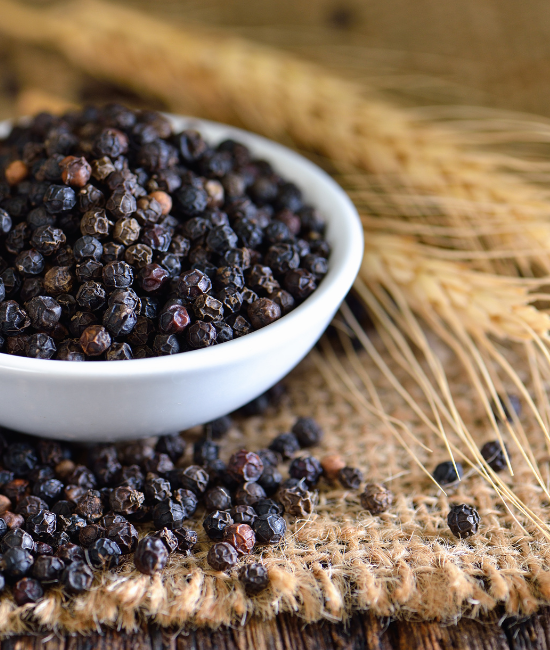
This natural shrinkage produces the familiar rough, wrinkled appearance of whole black peppercorns.
The final appearance can vary according to maturity at harvest, drying conditions and processing practices.
Well-processed whole peppercorns generally have a characteristic dark colour, sound structure and recognisable natural surface texture.
What makes it special? The distinctive wrinkled surface of Black Pepper is a natural result of the drying process rather than an artificially created feature.
7. Did You Know? The Size of a Peppercorn Is Important in Commercial Grading?
Black Pepper is commercially classified into different grades based on physical characteristics such as size, density, appearance and other quality parameters.
One commonly used measurement is Bulk Density, which indicates the mass of peppercorns occupying a given volume.
Another important measurement is Piperine Content, which helps assess the chemical composition and pungency characteristics of pepper.
Physical grading may also consider:
- Berry size and uniformity.
- Moisture content.
- Light berries.
- Extraneous matter.
- Damaged or broken berries.
- Foreign matter and other defects.
What makes it special? Premium whole pepper is evaluated through a combination of physical appearance, grading characteristics and laboratory quality parameters.
8. Did You Know? Black Pepper Is a Tropical Crop That Benefits from Shade?
Black Pepper grows naturally in humid tropical environments and is traditionally cultivated in regions receiving substantial rainfall.
The vines are commonly trained on suitable support trees or standards. Partial shade, adequate soil moisture, good drainage and suitable support structures are important cultivation considerations.
The Western Ghats provide favourable agroclimatic conditions for traditional pepper cultivation in several areas of Kerala.
The crop’s growth and productivity are influenced by rainfall distribution, temperature, soil conditions and farm management.
What makes it special? The natural growing environment plays an important role in shaping the cultivation and development of Black Pepper.
9. Did You Know? Black Pepper Has Been an Important Part of Kerala’s Maritime Trade?
Kerala’s connection with Black Pepper extends far beyond agriculture.
For centuries, pepper from the Malabar Coast was traded through maritime routes connecting India with markets in the Middle East, Europe and other parts of Asia.
Its high demand made it one of the most commercially important spices in historical international trade.
The expression Malabar Pepper continues to represent this historic connection between Kerala’s pepper-growing regions and global spice markets.
What makes it special? Black Pepper is not simply an agricultural commodity; it is part of Kerala’s historic contribution to international trade and cultural exchange.
10. Did You Know? Whole Peppercorns Can Retain Their Aroma Better Than Ground Pepper?
The characteristic aroma of Black Pepper comes from volatile essential oil constituents that can gradually escape when exposed to air.
When whole peppercorns are ground, their internal surfaces become exposed, allowing aromatic compounds to be released more readily.
This is why whole peppercorns generally retain their characteristic aroma longer than pre-ground pepper when stored properly.
For better preservation:
- Store whole peppercorns in airtight packaging.
- Keep away from moisture.
- Avoid excessive heat and direct sunlight.
- Store in a cool, dry place.
- Grind only the quantity required.
What makes it special? Keeping peppercorns whole helps preserve their natural aromatic character until the moment they are crushed or ground.
The Malabar Pepper Heritage – From Kerala’s High Ranges to the World
Malabar Black Pepper is an important part of India’s spice heritage, representing generations of cultivation, agricultural knowledge and international trade.
At HIGHLAND Spices, we take pride in our connection with the spice-growing landscape of Idukki, Kerala. Located in Manjapetty, Nedumkandam, Udumbanchola Taluk, our brand celebrates the traditional agricultural richness of the Western Ghats.
Our Malabar Black Pepper reflects the distinctive qualities that make this spice so valued: naturally occurring piperine, characteristic pungency, aromatic essential oils and the recognised geographical identity of Malabar Pepper.
As a GI-authorised user of Malabar Black Pepper, HIGHLAND Spices is committed to presenting this recognised geographical product with careful attention to selection, processing, freshness and quality.
HIGHLAND Spices – Bringing the Bold Aroma and Heritage of Malabar Pepper to the World.