
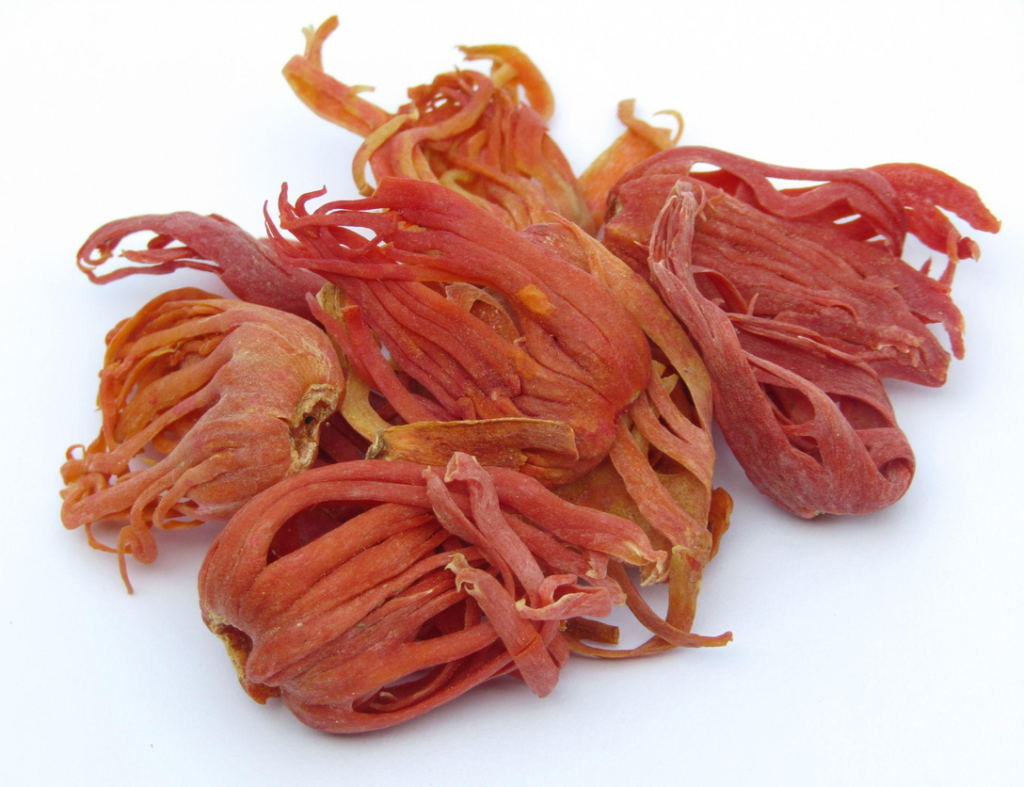
Among the many remarkable spices cultivated in the tropical highlands of Kerala, Highrange Red Mace holds a distinctive place for its beautiful natural colour, delicate structure and rich aromatic character. Commonly known as nutmeg mace, this premium whole spice is obtained from the bright reddish-orange covering surrounding the nutmeg seed. Although nutmeg and mace originate from the same fruit, each has its own physical characteristics, chemical composition and aromatic identity.
Associated with the spice-growing landscapes of the Western Ghats, mace reflects the remarkable botanical diversity and agricultural heritage of Kerala. The high ranges of Idukki, with their established tradition of spice cultivation, are particularly significant to the regional identity of this spice.
At HIGHLAND Spices, Highrange Red Mace represents an appreciation of the distinctive whole spices associated with Idukki. Understanding its botanical origin, natural composition, harvesting and processing helps explain why this delicate spice is valued in premium whole-spice selections.
1. What Exactly Is Highrange Red Mace?
Red mace is the dried aril of the nutmeg fruit, scientifically known as Myristica fragrans Houtt., an evergreen tropical tree belonging to the family Myristicaceae.
The aril is a naturally occurring, fleshy and intricately branched covering that surrounds the hard shell of the nutmeg seed. When the fruit reaches maturity, its outer covering splits open, exposing the bright red aril and the seed within.
The two commercially important spices obtained from this single fruit are:
- Nutmeg: The kernel obtained from inside the hard seed shell.
- Mace: The dried, net-like aril surrounding the seed.
Although both originate from the same botanical source, their physical structure, essential oil profiles and sensory characteristics are different.
Mace is particularly appreciated for its delicate reddish-orange strands, warm fragrance and distinctive aromatic complexity. Unlike the compact nutmeg kernel, its naturally branched structure gives it a visually recognisable appearance among whole spices.
2. The Science Behind Its Distinctive Red Colour
One of the most attractive features of Highrange Red Mace is its naturally occurring reddish-orange colour.
This colour is associated with carotenoid pigments present in the mace aril. Research on nutmeg fruit and its aril has identified carotenoid compounds, including lycopene, which contributes to red pigmentation in various fruits and plant tissues.
As the fresh aril undergoes drying, its colour changes due to moisture loss, pigment transformation and exposure to environmental conditions. Consequently, dried mace may display shades ranging from reddish-orange and orange-yellow to deeper brownish-orange.
The final colour is influenced by several factors:
- Maturity of the nutmeg fruit at harvesting.
- Natural pigment composition.
- Separation and handling practices.
- Drying temperature and duration.
- Exposure to sunlight, oxygen and moisture.
An important quality consideration: A naturally attractive colour should be assessed alongside aroma, cleanliness, texture and freedom from mould or deterioration. Colour alone cannot establish the quality or purity of mace.
3. Essential Oil: The Chemistry Behind Mace’s Aroma
The characteristic fragrance of mace comes largely from its volatile aromatic compounds, collectively known as essential oil.
Scientific investigations have demonstrated that mace contains a complex mixture of naturally occurring terpenes and other aromatic constituents. These compounds contribute to its warm, sweet, woody, slightly peppery and characteristic spice-like fragrance.
A particularly relevant scientific study by Ashokkumar and colleagues investigated the essential oil composition of different parts of Myristica fragrans grown in the Western Ghats of South India.
The study reported an essential oil yield of approximately 8.1% (volume by weight, v/w) from the mace sample examined.
The major constituents reported were:
| Aromatic compound | Reported proportion |
| Sabinene | 38.4% |
| Alpha-pinene | 8.2% |
| Beta-pinene | 7.6% |
| Limonene | 7.1% |
| Myristicin | 5.9% |
| 3-Carene | 5.1% |
| 4-Carene | 4.2% |
| Safrole | 3.9% |
| Beta-phellandrene | 3.6% |
| Terpinen-4-ol | 3.0% |
Source: Ashokkumar et al., research on the compositional variation in nutmeg leaf, mace, kernel and seed essential oils from the Western Ghats, India. Percentages refer to the relative composition of the analysed essential oil, not the percentage of these compounds in the whole spice.
PMC+1
These findings help explain the complex aromatic identity of mace. Sabinene, in particular, was the predominant compound in the studied Western Ghats mace oil.
It is important to understand that essential oil composition varies with cultivar, growing environment, fruit maturity, processing and extraction methodology. These research values should not be treated as fixed specifications for every commercial batch.
4. Mace and Nutmeg: Two Spices with Different Chemical Profiles
Although nutmeg and mace develop within the same fruit, their chemical compositions are not identical.
The nutmeg kernel contains a considerable quantity of fixed oil, commonly called nutmeg butter, in addition to its volatile essential oil. Mace also contains both fixed and volatile oil fractions, but their relative proportions and chemical composition differ.
A comparative scientific study published in 2025 reported the following composition for the analysed samples:
| Oil fraction | Nutmeg | Mace |
| Total oil | 34.47% | 22.55% |
| Essential oil | 5.95% | 8.79% |
| Fixed oil | 26.43% | 23.73% |
Source: Comparative study of fixed, total and essential oils from nutmeg seed and mace aril. Values are specific to the samples and analytical methods used in the study.
PubMed
The findings demonstrate an interesting distinction: the analysed mace sample contained a higher proportion of essential oil than the analysed nutmeg sample, while the nutmeg sample contained more total oil.
This is one scientific reason why mace has its own distinctive aromatic identity and commercial value.
5. The Nutmeg Tree: Botanical Characteristics and Growth
The nutmeg tree is an evergreen tropical species that thrives in warm, humid environments with adequate rainfall and well-drained soil.
Its botanical name is Myristica fragrans Houtt. It is native to the Moluccas of Indonesia but is now cultivated in several tropical regions, including India, Sri Lanka, Indonesia and Grenada.
Some interesting botanical characteristics include:
- Plant type: Evergreen perennial spice tree.
- Plant family: Myristicaceae.
- Flowers: Small, inconspicuous flowers.
- Reproductive nature: Generally dioecious, with male and female flowers on separate trees.
- Fruit: Fleshy, generally yellow when mature.
- Seed: Protected by a hard shell.
- Aril: The red, naturally branched covering that becomes mace after drying.
The tree produces both nutmeg and mace, making it an economically important perennial spice crop. Its fruiting cycle and the development of its aril are particularly interesting from an agricultural and botanical perspective.
6. Why the Western Ghats Are Important for Nutmeg Cultivation
The Western Ghats are among India’s important tropical biodiversity regions and provide suitable growing environments for several commercially valuable spices.
Kerala has a long-established tradition of nutmeg cultivation, with districts such as Idukki, Ernakulam, Thrissur and Kottayam contributing to the state’s nutmeg production.
The combination of tropical temperatures, seasonal rainfall, humidity and suitable soils supports the cultivation of nutmeg trees in many parts of this region.
According to Kerala’s Agricultural Statistics 2022–23, the recorded district-wise nutmeg cultivation area included:
| District | Nutmeg cultivation area |
| Thrissur | 7,104.96 ha |
| Ernakulam | 6,804.19 ha |
| Idukki | 3,623.43 ha |
| Kottayam | 2,537.86 ha |
Source: Department of Economics and Statistics, Government of Kerala, Agricultural Statistics 2022–23. These are historical area figures, not current-year estimates.
Karshika Keralam
The figures illustrate Idukki’s significant place in Kerala’s nutmeg-growing landscape.
For HIGHLAND Spices, the regional association is particularly meaningful. The brand is nestled in Manjapetty, Nedumkandam, in Udumbanchola Taluk of Idukki District, Kerala, within the wider spice-growing high ranges of the Western Ghats.
7. Harvesting: From Ripe Nutmeg Fruit to Red Mace
The production of quality mace begins with the selection of properly matured nutmeg fruits.
Unlike spices harvested as leaves, bark or flower buds, mace is obtained from the fruit of a perennial tree. Harvesting and post-harvest handling therefore play important roles in preserving its natural appearance and quality.
Step 1 – Fruit maturity
Mature nutmeg fruits generally develop a yellowish outer appearance. As the fruit ripens, the outer flesh naturally splits open, revealing the red mace surrounding the seed.
Step 2 – Harvesting
Ripe fruits are collected from the trees or gathered after natural falling, depending on the cultivation and harvesting practices followed.
Step 3 – Separation of mace
The red aril is carefully separated from the nutmeg seed. Because its structure is delicate and naturally branched, rough handling may cause excessive breakage.
Step 4 – Cleaning
The separated mace is inspected and cleaned to remove unwanted fruit remnants and foreign matter.
Step 5 – Drying
Fresh mace contains considerably more moisture than its dried commercial form. Controlled drying reduces moisture and develops the characteristic texture of dried mace.
Step 6 – Grading and packing
The dried material is inspected for colour, cleanliness, physical integrity, aroma and moisture condition before suitable grading and protective packaging.
The care taken at each stage contributes to the appearance, aromatic character and storage stability of the finished spice.
8. Drying and Moisture: An Important Scientific Aspect of Mace Quality
Drying is one of the most important post-harvest operations in mace processing.
Freshly separated mace contains moisture that must be reduced to a suitable level before storage and commercial distribution. Excess residual moisture can encourage mould development and other forms of deterioration.
During drying, several changes occur:
- Moisture content decreases.
- The fresh, flexible aril becomes brittle.
- The colour changes from bright red to orange, yellowish-orange or brownish-orange.
- The aroma becomes characteristic of dried mace.
- The product becomes more suitable for storage and transportation.
However, drying must be properly managed. Excessive heat and prolonged exposure to unsuitable environmental conditions may affect colour and volatile aromatic compounds.
Why does this matter?
Mace is valued partly for its naturally occurring volatile compounds. Preserving these compounds through appropriate drying and storage practices is important for maintaining its characteristic fragrance.
9. Oleoresin: Another Valuable Component of Mace
Apart from essential oil, mace also contains oleoresin, a concentrated extract containing volatile aromatic constituents and non-volatile components.
Oleoresin is commercially important because it captures a broader range of the spice’s flavour and aromatic characteristics than essential oil alone.
A nutmeg variety released by ICAR–Indian Institute of Spices Research, known as Keralamshree, provides an interesting example of the chemical and agricultural potential of nutmeg.
Its reported quality characteristics include:
| Quality parameter | Reported value |
| Mace oil | 7.5% |
| Mace oleoresin | 9.1% |
| Myristicin in mace oil | 9.4% |
| Sabinene in mace oil | 29.4% |
| Alpha-pinene in mace oil | 4.7% |
The variety is also described as producing dark-red, thick and entire mace.
Indian Institute of Spices Research
These figures demonstrate how the selection of nutmeg varieties can influence the physical and chemical characteristics of the mace obtained.
It is worth noting that these are variety-specific research values, not universal specifications for all Highrange Red Mace.
10. What Makes Whole Red Mace Different from Ground Mace?
Whole mace and ground mace are two different commercial presentations of the same spice.
Whole mace retains its naturally branched structure, making it easier to assess its physical appearance, colour and visible cleanliness.
Ground mace, on the other hand, has a much larger exposed surface area. This can increase its contact with oxygen and moisture, potentially accelerating the loss of delicate volatile aromatic compounds.
| Characteristic | Whole mace | Ground mace |
| Physical form | Natural dried strands | Fine powder |
| Appearance | Reddish-orange to brownish-orange | Orange to brownish powder |
| Surface exposure | Relatively lower | Higher |
| Visual inspection | Easier to inspect individual strands | More difficult to assess physical identity |
| Storage | Requires airtight protection | Requires particularly careful moisture and oxygen protection |
For customers who appreciate the natural appearance and distinctive character of premium whole spices, whole mace offers an opportunity to experience the spice in its original dried form.
11. Natural Compounds That Define Mace’s Character
Mace contains a variety of naturally occurring chemical constituents. These compounds are responsible for its characteristic aroma and contribute to its botanical and commercial importance.
Some important compounds include:
| Compound | Scientific significance |
| Sabinene | A major monoterpene contributing to aromatic character |
| Alpha-pinene | A naturally occurring aromatic monoterpene |
| Beta-pinene | A volatile terpene found in several aromatic plants |
| Limonene | A naturally occurring citrus-associated terpene |
| Myristicin | A naturally occurring phenylpropene |
| 3-Carene | A monoterpene found in the essential oil |
| Terpinen-4-ol | An oxygenated monoterpene |
These constituents are studied through analytical techniques such as gas chromatography–mass spectrometry (GC-MS).
GC-MS helps researchers identify and estimate the relative abundance of volatile compounds in essential oils. This makes it an important analytical technique for understanding the chemical profile of different nutmeg varieties and their mace.
Importantly, the chemical composition of mace is not identical across all geographical regions, varieties and harvests.
12. Factors That Influence the Quality of Premium Highrange Red Mace
The quality of dried mace is influenced by a combination of agricultural, botanical and post-harvest factors.
The following characteristics are important when assessing premium whole mace:
Natural colour: Well-preserved mace generally displays an attractive natural orange, reddish-orange or deeper orange-brown appearance.
Aromatic intensity: A characteristic warm, sweet and slightly peppery fragrance is an important sensory feature.
Physical integrity: Larger, reasonably intact mace blades are visually attractive and easier to identify than excessively fragmented material.
Cleanliness: Good-quality mace should be free from visible foreign matter, excessive dust and unwanted contaminants.
Moisture condition: Properly dried mace should have a suitable moisture level for safe storage.
Storage condition: Protection from moisture, excessive heat, oxygen and direct sunlight helps preserve its natural characteristics.
For commercial quality evaluation, these sensory observations can be supplemented by laboratory analysis of moisture, volatile oil, extraneous matter and other applicable parameters.
13. How to Preserve the Natural Aroma and Freshness of Red Mace
Mace contains volatile aromatic compounds that can gradually deteriorate when exposed to unsuitable storage conditions.
To maintain its characteristic aroma and physical quality, proper storage is essential.
Recommended storage practices include:
- Store in a clean, dry and airtight container.
- Keep away from direct sunlight.
- Avoid exposure to excessive heat.
- Protect from moisture and humidity.
- Avoid frequent exposure to open air.
- Use clean, dry utensils when handling the spice.
Whole mace, when properly dried and stored, can retain its characteristic fragrance and physical appearance for longer than poorly protected material.
14. Why Highrange Red Mace Is a Distinctive Whole Spice
Highrange Red Mace brings together several distinctive characteristics that make it an interesting and valuable whole spice.
Its botanical uniqueness, natural reddish-orange colour, delicate structure and complex essential oil composition distinguish it from many other spices.
What makes it particularly interesting is the combination of:
- Botanical uniqueness: It is the natural aril surrounding the nutmeg seed.
- Distinctive appearance: Its delicate, branching strands have a characteristic reddish-orange colour.
- Aromatic complexity: Its essential oil contains several naturally occurring volatile compounds.
- Scientific importance: Its chemical composition and oil characteristics have been investigated in research on Western Ghats nutmeg.
- Regional significance: Nutmeg cultivation forms an important part of Kerala’s spice-growing agricultural landscape.
- Processing sensitivity: Careful harvesting, separation, drying and storage are essential to preserving its natural qualities.
These characteristics make whole red mace an interesting choice for customers who appreciate distinctive, naturally aromatic spices.
15. HIGHLAND Spices – Celebrating the Character of Highrange Red Mace
At HIGHLAND Spices, we appreciate the natural diversity and distinctive character of spices associated with Kerala’s high ranges.
Our Highrange Red Mace reflects our connection with the spice-growing landscape of Idukki, Kerala, where the agricultural heritage of the Western Ghats is closely associated with premium whole spices.
Nestled in Manjapetty, Nedumkandam, in Udumbanchola Taluk of Idukki District, HIGHLAND Spices brings together an appreciation of regional spice-growing traditions and a commitment to carefully selected whole spices.
Our focus is on preserving the natural identity of each spice through attention to selection, handling, cleanliness and freshness-conscious packaging.
We believe that understanding a spice’s botanical origin, natural composition and journey from harvest to packing makes the experience of choosing quality spices more meaningful.
HIGHLAND Spices – Experience the natural aroma, distinctive character and authentic spice heritage of Idukki.