
By HIGHLAND Spices – From the Cardamom Hills of Idukki
Introduction: Understanding the Grades of Alleppey Green Cardamom
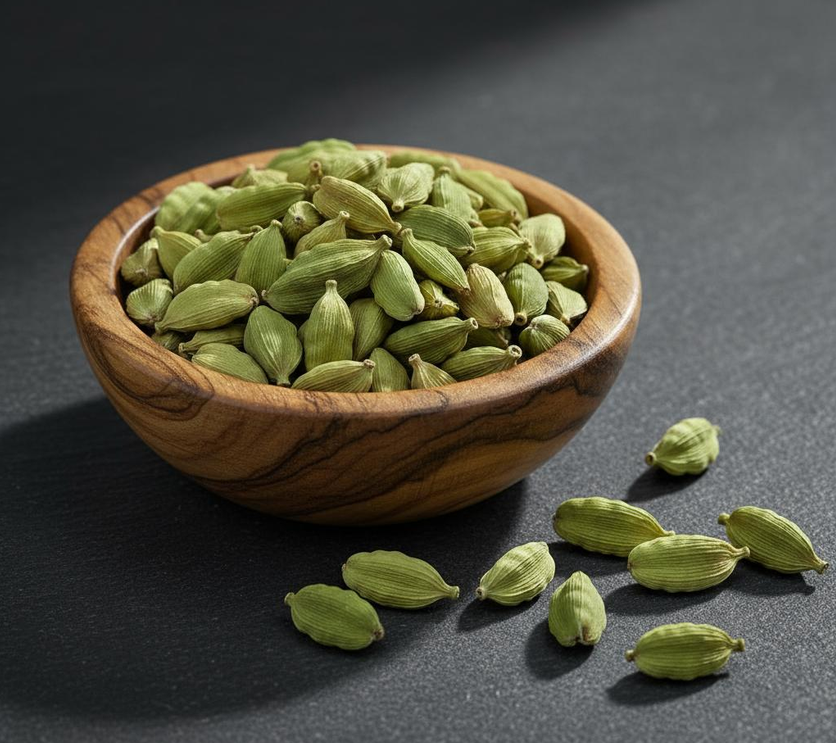
Alleppey Green Cardamom, widely recognised for its distinctive green appearance, refreshing aroma and characteristic flavour, is among India’s most valued spice varieties in international markets. Cultivated in the tropical high ranges of Kerala, particularly the Cardamom Hills of the Western Ghats, it has earned recognition in the global spice trade for its distinctive physical and aromatic characteristics.
However, not all green cardamom available in the market is identical. Differences in pod size, colour, weight, maturity, moisture content, aroma and physical appearance influence how cardamom is classified and marketed.
This is where cardamom grading becomes important.
Cardamom grades help buyers, wholesalers, retailers, importers and spice processors understand the physical characteristics of the product they are purchasing. Among the different grading parameters, pod size is one of the most commonly used indicators in commercial trade.
For buyers sourcing premium Alleppey Green Cardamom from Kerala, understanding these grades is essential for making informed purchasing decisions, maintaining product consistency and identifying the right specification for their business requirements.
In this guide, HIGHLAND Spices explains the different commercial grades of Alleppey Green Cardamom, the significance of pod size, important quality parameters and the factors buyers should consider when selecting green cardamom.
1. What Is Cardamom Grading?
Cardamom grading is the process of classifying harvested and processed green cardamom according to specific physical and quality characteristics.
The grading process helps distinguish commercial lots based on parameters such as:
- Pod size: The diameter of individual cardamom pods, generally measured in millimetres.
- Colour: The external green colour and its uniformity.
- Appearance: Overall pod shape, surface condition and visual presentation.
- Weight and density: The physical fullness and weight of the pods.
- Moisture content: The amount of moisture retained after drying.
- Aroma: The characteristic fragrance associated with cardamom’s natural volatile compounds.
- Cleanliness: The presence or absence of dust, stalks, foreign matter and other impurities.
- Maturity: The development and physical condition of the harvested pods.
In commercial markets, cardamom is frequently classified using size-based specifications such as 8 mm, 7 mm and 6 mm. However, size alone does not establish the complete quality of a cardamom lot.
A larger pod may command a premium in certain markets because of its visual appeal, but colour, aroma, cleanliness, moisture and seed development also contribute to its overall commercial value.
2. Major Commercial Grades of Alleppey Green Cardamom
Alleppey Green Cardamom is traditionally classified into different grades according to pod diameter and other physical characteristics.
The recognised grade designations include:
- AGEB – Alleppey Green Extra Bold
- AGB – Alleppey Green Bold
- AGS – Alleppey Green Superior
- AGS-1 – Alleppey Green Shipment Green-1
- AGS-2 – Alleppey Green Shipment Green-2
The following table presents the commonly referenced traditional export-grade specifications.
Cardamom grades and their specifications
| Grade | Full form | Traditional size specification | Reference weight per litre |
| AGEB | Alleppey Green Extra Bold | 7 mm and above | 435 g |
| AGB | Alleppey Green Bold | 6 mm and above | 415 g |
| AGS | Alleppey Green Superior | 5 mm and above | 385 g |
| AGS-1 | Shipment Green-1 | 4 mm and above | 350 g |
| AGS-2 | Shipment Green-2 | 4 mm and above | 320 g |
Reference values from traditional Indian export-grade classifications. Actual contractual specifications and grading tolerances should be confirmed for each consignment.
Technology of spices and condiments+2
An important distinction is necessary here: the traditional AGEB designation starts at 7 mm, whereas some contemporary retail and export suppliers use additional commercial subdivisions such as 8 mm and above, 7–8 mm and 6–7 mm. These should not automatically be treated as identical to the traditional grade designations.
2.1 AGEB – Alleppey Green Extra Bold
AGEB – Alleppey Green Extra Bold
- Traditional minimum diameter: 7 mm
- Reference bulk density: 435 g/litre
- Characteristic: Large, well-developed pods
- Market positioning: Premium whole-cardamom segment
AGEB is one of the most recognised premium grades of Alleppey Green Cardamom. It represents larger-sized pods selected through size-based grading.
The pods generally offer an attractive physical appearance, particularly when the lot has uniform green colour, good pod development and minimal defects.
AGEB is particularly relevant to buyers seeking a premium visual presentation, including spice retailers, speciality food businesses, gift-pack manufacturers and international spice traders.
A higher litre weight can indicate better pod fullness and density, although it should always be assessed alongside moisture content and other quality parameters.
2.2 AGB – Alleppey Green Bold
AGB – Alleppey Green Bold
- Traditional minimum diameter: 6 mm
- Reference bulk density: 415 g/litre
- Characteristic: Medium-to-large sized pods
- Market positioning: Commercial and export-grade whole cardamom
AGB is another widely recognised commercial grade. It includes pods that meet the specified minimum size requirement and provides buyers with a practical balance between pod size and commercial value.
This grade is relevant for wholesale distribution, retail packaging and businesses looking for consistent whole green cardamom specifications.
The overall quality of AGB depends on the uniformity of the lot, natural colour, aroma, seed development, moisture and cleanliness.
2.3 AGS – Alleppey Green Superior
AGS – Alleppey Green Superior
- Traditional minimum diameter: 5 mm
- Reference bulk density: 385 g/litre
- Characteristic: Smaller-sized whole pods
- Market positioning: General commercial and processing requirements
AGS represents a smaller size category compared with AGEB and AGB.
Although the pods are smaller, size alone should not be interpreted as an indication of inferior aroma or flavour. Properly harvested, dried and stored smaller pods can retain desirable aromatic characteristics.
This grade may be suitable for buyers whose purchasing specifications prioritise functional quality and commercial value rather than larger pod dimensions.
2.4 AGS-1 – Alleppey Green Shipment Green-1
AGS-1 – Shipment Green-1
- Traditional minimum size: 4 mm
- Reference bulk density: 350 g/litre
- Characteristic: Smaller-sized commercial pods
- Market positioning: Shipment and bulk trade
AGS-1 is a traditional shipment-grade classification for smaller-sized cardamom. It is generally considered in commercial transactions where the buyer’s requirements are based on size distribution, physical condition and agreed quality specifications.
2.5 AGS-2 – Alleppey Green Shipment Green-2
AGS-2 – Shipment Green-2
- Traditional classification: Shipment grade
- Reference bulk density: 320 g/litre
- Characteristic: Smaller-sized pods
- Market positioning: Bulk commercial requirements
AGS-2 is another shipment-grade category within the traditional Alleppey Green Cardamom classification. Buyers should evaluate the actual lot specifications, including the proportion of small pods, light pods, splits and other defects, before purchasing.
The traditional AGS-1 and AGS-2 specifications are drawn from published Indian export-grade references.
Technology of spices and condiments+1
3. Understanding 6 mm, 7 mm, 8 mm and 8.5 mm Cardamom
In today’s cardamom trade, buyers frequently encounter specifications such as 6 mm, 7 mm, 8 mm, 8.5 mm and 9 mm.
These measurements refer to the approximate diameter of the cardamom pods, not their length.
Common market size classifications
| Market specification | Description | Commercial positioning |
| 8.5 mm and above | Very large pods | Speciality premium selection |
| 8 mm and above | Extra-large pods | Premium retail and export |
| 7–8 mm | Large pods | Premium commercial grade |
| 6–7 mm | Medium-sized pods | General commercial grade |
| 5–6 mm | Smaller pods | Value-oriented whole spice segment |
| Below 5 mm | Very small pods | Subject to specific buyer requirements |
Important: These are illustrative market size bands, not a replacement for the traditional AGEB, AGB and AGS grade definitions. The actual size distribution and sieve-retention criteria must be stated in the purchase specification.
For example, a consignment described as 8 mm and above should specify whether all pods must meet that minimum or whether a particular percentage is permitted below the stated size.
Why are larger cardamom pods preferred in certain markets?
Larger pods are often preferred for their:
- Attractive and prominent appearance.
- Better suitability for premium retail presentation.
- Visual uniformity in packaged products.
- Higher perceived commercial value.
- Suitability for speciality whole-spice markets.
However, larger pod size does not automatically guarantee stronger aroma, higher essential oil content or superior flavour. These characteristics require separate assessment and, where necessary, laboratory testing.
4. How Is Green Cardamom Graded?
Cardamom grading generally involves a systematic process of cleaning, sorting, screening and quality inspection.
The objective is to separate pods according to size and physical condition while removing unwanted materials and identifying defects.
Step 1: Cleaning and pre-sorting
After harvesting and drying, cardamom pods undergo preliminary cleaning.
This stage removes:
- Dust and loose particles.
- Dried stalks and plant residues.
- Foreign matter.
- Damaged and visibly defective pods.
Step 2: Size separation
The cleaned cardamom is passed through grading screens or sieves with different aperture sizes.
The separation process allows pods to be classified according to their diameter.
Larger pods are retained on screens with larger openings, while smaller pods pass through to subsequent grading stages.
Step 3: Colour sorting
Colour is an important commercial consideration, particularly for premium green cardamom.
Depending on the processing and sorting facilities, colour sorting may be carried out manually or using optical sorting equipment.
The objective is to achieve a more consistent appearance and remove visibly discoloured pods.
Step 4: Removal of defective pods
The product is inspected to identify:
- Split or open pods.
- Blackened or damaged pods.
- Empty and poorly developed pods.
- Insect-damaged material.
- Excessively shrivelled pods.
Step 5: Final quality inspection
The graded material is assessed for moisture, cleanliness, appearance and other relevant quality specifications.
For export consignments, additional laboratory testing may be required depending on the destination market and contractual requirements.
5. Important Quality Parameters Beyond Pod Size
A reliable cardamom buyer should never evaluate a consignment exclusively by its millimetre grade.
Several other characteristics determine the actual quality and commercial suitability of green cardamom.
5.1 Natural Green Colour
Colour is one of the first characteristics buyers observe.
Premium green cardamom is generally valued for its attractive, reasonably uniform natural green appearance.
Colour variations may arise from:
- Harvest maturity.
- Drying temperature and duration.
- Handling and storage conditions.
- Exposure to moisture and sunlight.
- Natural differences between individual pods.
An excessively uniform or unusually bright colour should not be treated as proof of quality. Buyers should verify that the colour is natural and that no unauthorised colouring treatment has been applied.
5.2 Bulk Density or Litre Weight
Bulk density is an important commercial parameter in cardamom trading.
It is commonly expressed as grams per litre (g/L) and indicates the weight of a measured volume of cardamom pods.
For example:
- AGEB: approximately 435 g/L.
- AGB: approximately 415 g/L.
- AGS: approximately 385 g/L.
These are traditional reference values, not guaranteed values for every commercial lot.
Higher bulk density can indicate fuller, heavier pods, but moisture and the method of measurement also influence the result.
5.3 Moisture Content
Moisture content influences storage stability, product condition and shelf life.
Excess moisture can encourage mould development and deterioration during storage, while excessive drying may affect the physical condition of the pods.
Buyers should specify the acceptable moisture limit in their purchase contracts and verify it using an appropriate testing method.
5.4 Aroma and Volatile Oil
The characteristic fragrance of green cardamom is associated with its naturally occurring volatile aromatic compounds.
Important constituents include:
- 1,8-Cineole.
- α-Terpinyl acetate.
- Linalool.
- Linalyl acetate.
The relative composition of these compounds contributes to cardamom’s distinctive sweet, fresh, floral and slightly camphoraceous aromatic profile.
Aroma and volatile oil content are separate quality parameters and cannot be reliably determined by pod diameter alone.
5.5 Seed Development and Pod Fullness
A well-developed cardamom pod generally contains properly formed seeds within its outer husk.
Pod fullness is relevant when evaluating the physical quality of a lot.
Buyers should examine the proportion of:
- Fully developed pods.
- Poorly filled pods.
- Empty pods.
- Damaged and split pods.
5.6 Cleanliness and Foreign Matter
Cleanliness is particularly important for retail packaging and international trade.
A good-quality consignment should be assessed for dust, stalks, stones, foreign plant material and other extraneous matter.
The acceptable percentage should be established through the relevant product specification and testing requirements.
6. Alleppey Green Cardamom: Origin and Geographical Identity
Alleppey Green Cardamom has a distinctive place in India’s spice trade and is associated with the traditional cardamom-growing regions of Kerala. The geographical identity of Alleppey Green Cardamom is recognised under India’s Geographical Indication framework. The GI product specification describes characteristic features including:
| Parameter | GI specification reference |
| Colour | Uniform green |
| Length | Approximately 21 mm |
| Diameter | 5–8 mm |
| Shape | Three-cornered, ribbed appearance |
| Bulk density | 260–435 g/L |
| Volatile oil content | 7.5–11.3% |
| Odour | Sweet, fruity and floral |
These are product specification references, not guaranteed measurements for every individual pod or consignment.
The importance of Idukki in cardamom production
Idukki is one of India’s important cardamom-growing districts. Its high-range agricultural landscape, tropical growing conditions and long-established spice cultivation traditions make it an important sourcing region for green cardamom.
HIGHLAND Spices is nestled in Manjapetty, Nedumkandam, in Udumbanchola Taluk of Idukki District, Kerala.
Our association with the high ranges of Idukki reflects our focus on the region’s whole-spice heritage, particularly premium green cardamom and other traditional spices.
For buyers, understanding the origin of a product is just as important as understanding its grade. Origin, traceability, harvesting practices, processing and storage all contribute to the overall product identity.
GI recognition and commercial grading are different concepts: GI identifies the recognised geographical product identity and its defined specifications, whereas commercial grades classify individual lots according to agreed physical and quality parameters.
7. How to Choose the Right Cardamom Grade
The ideal cardamom grade depends on the buyer’s intended market, product presentation, price expectations and technical requirements.
| Buyer category | Suggested grade consideration | Main purchasing priority |
| Premium spice retailers | AGEB / larger size selections | Appearance and uniformity |
| Speciality spice stores | AGEB / AGB | Colour, size and presentation |
| Wholesale distributors | AGB / AGS | Consistent specifications |
| Food manufacturers | AGS and other agreed sizes | Aroma and processing suitability |
| Export importers | Contract-specific grades | Size, density, moisture and compliance |
| Gift hamper manufacturers | Large, uniform pods | Visual appeal and presentation |
What should importers and wholesalers check?
Before finalising a bulk purchase, buyers should consider the following:
- Grade designation: Confirm whether the product is AGEB, AGB, AGS or another agreed commercial specification.
- Pod diameter: Establish the minimum size and permitted size distribution.
- Colour consistency: Check natural colour and uniformity.
- Bulk density: Verify the litre weight.
- Moisture: Request a moisture test report.
- Aroma: Assess the natural fragrance and freshness.
- Defective pods: Check splits, blackened pods, empty pods and damaged material.
- Foreign matter: Confirm cleanliness and acceptable limits.
- Residue compliance: Check pesticide residue requirements for the destination market.
- Traceability: Verify sourcing region, batch identification and processing details.
For international buyers, the purchase agreement should clearly identify the product grade, testing requirements, applicable tolerances, packaging and destination-country compliance requirements.
8. Difference Between Cardamom Size and Cardamom Quality
One of the most common misconceptions in the spice market is that bigger cardamom pods are always better in quality.
Although larger pods often attract premium pricing, quality is determined by several independent factors.
Consider two hypothetical consignments:
| Quality parameter | Lot A | Lot B |
| Pod diameter | 8 mm+ | 7 mm+ |
| Colour | Uneven | Uniform natural green |
| Aroma | Weak | Fresh and characteristic |
| Pod development | Poorly filled | Well developed |
| Moisture | Outside agreed limit | Within agreed limit |
| Cleanliness | More foreign matter | Properly cleaned |
Although Lot A contains larger pods, Lot B may be the better-quality purchase.
This illustrates why professional buyers should assess the complete specification instead of relying exclusively on size labels.
The most suitable cardamom is not necessarily the largest; it is the one that consistently meets the buyer’s complete quality requirements.
9. Why Proper Cardamom Grading Matters in the Spice Industry
Grading plays an important role throughout the cardamom supply chain, from farmers and processors to wholesalers, retailers and international importers.
Its importance can be understood through the following benefits:
1. Consistent Product Specifications
Grading helps suppliers maintain consistent pod-size distribution and physical characteristics across different consignments.
2. Transparent Commercial Transactions
Clearly defined grades allow buyers and sellers to establish pricing and purchasing specifications based on measurable parameters.
3. Better Market Segmentation
Different grades enable suppliers to cater to premium retail, wholesale distribution, speciality spice markets and industrial requirements.
4. Improved Quality Control
Systematic sorting and inspection help identify defective pods, foreign matter and variations in product quality.
5. International Trade Compatibility
Standardised product descriptions and clearly documented specifications make communication between exporters and importers easier.
10. Frequently Asked Questions About Alleppey Green Cardamom Grades
1. What are the main grades of Alleppey Green Cardamom?
The traditional commercial export classifications include AGEB (Alleppey Green Extra Bold), AGB (Alleppey Green Bold), AGS (Alleppey Green Superior), AGS-1 (Shipment Green-1) and AGS-2 (Shipment Green-2).
2. What is AGEB cardamom?
AGEB stands for Alleppey Green Extra Bold. Its traditional grade specification is 7 mm and above, with a reference bulk density of approximately 435 grams per litre.
3. What is the difference between AGEB and AGB?
AGEB has a traditional minimum pod diameter of 7 mm, whereas AGB has a minimum diameter of 6 mm. Their traditional reference bulk densities are approximately 435 g/L and 415 g/L respectively.
4. Is 8 mm cardamom better than 7 mm cardamom?
An 8 mm selection offers larger pods and is often preferred for premium visual presentation. However, the actual quality also depends on colour, aroma, seed development, moisture and cleanliness.
5. What does 8.5 mm cardamom mean?
It refers to a commercial size specification indicating pods with a diameter of approximately 8.5 mm or greater, subject to the supplier’s sieve classification and agreed tolerances.
6. How is cardamom size measured?
Cardamom size is generally determined by passing the pods through calibrated grading sieves. The sieve aperture determines the size fraction, and the results are expressed in millimetres.
7. Does larger cardamom contain more essential oil?
Not necessarily. Essential oil content varies with variety, growing conditions, maturity, harvesting, drying and storage. It must be determined through appropriate laboratory testing rather than inferred from pod size.
8. What is bulk density in cardamom?
Bulk density, commonly expressed in grams per litre, measures the weight of cardamom pods occupying a specified volume. It is useful for assessing the physical characteristics and fullness of a commercial lot.
9. Is Alleppey Green Cardamom GI recognised?
Yes. Alleppey Green Cardamom has Geographical Indication recognition in India. Its GI product specification identifies its geographical identity and characteristic product attributes.
10. Which cardamom grade is suitable for export?
The suitable grade depends on the destination market, buyer requirements, product application and agreed specifications. AGEB, AGB and AGS are among the traditional commercial classifications used in the trade.
11. HIGHLAND Spices – Premium Whole Spices from the Highlands of Idukki, Kerala
At HIGHLAND Spices, we believe that the identity of a premium spice begins with its origin and continues through careful selection, processing and packing.
Nestled in Manjapetty, Nedumkandam, in Udumbanchola Taluk of Idukki District, Kerala, HIGHLAND Spices is dedicated to bringing the distinctive spice heritage of the high ranges to customers across India and international markets.
Our focus is on premium whole spices, including Alleppey Green Cardamom and Malabar Black Pepper, alongside other carefully selected spices from the high ranges.
As a Trade Mark Registered Brand, HIGHLAND Spices is committed to maintaining product identity, quality consistency and customer confidence. Our Alleppey Green Cardamom and Malabar Black Pepper are GI-authorised products.
We recognise that different buyers have different requirements. Whether you are a retailer looking for attractive green cardamom pods, a wholesaler sourcing consistent commercial grades or an international importer seeking clearly defined product specifications, understanding the grade is an important starting point.
Discover the authentic spice heritage of Idukki with HIGHLAND Spices – Finest Spices from the Misty Highlands of Idukki, Kerala.