
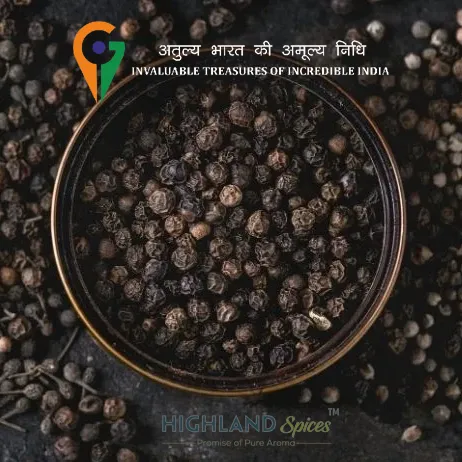
Celebrating the Geographical Heritage, Authenticity and Traditional Excellence of Malabar Black Pepper
Among India’s most treasured spices, black pepper holds a special place in the country’s agricultural history and culinary heritage. Often known as the King of Spices, black pepper has been valued for generations for its distinctive pungency, rich aroma and versatility. Of the many varieties associated with Indian spice cultivation, Malabar Black Pepper stands out for its geographical identity and long-standing reputation. Closely associated with the traditional spice-growing regions of South India, Malabar Black Pepper represents a remarkable connection between geographical origin, farming traditions and agricultural excellence. Its identity is deeply rooted in the history of Kerala and the Western Ghats, where favorable tropical conditions have supported pepper cultivation for generations. At HIGHLAND Spices, we are proud to be an Authorized GI Tag User of Malabar Black Pepper. This recognition reflects our association with a geographically recognized Indian spice and our appreciation for the heritage behind its identity.
For us, Malabar Black Pepper is more than a product. It represents the dedication of farming communities, the richness of India’s spice-growing regions and the traditions that have made Indian spices valued across the world.
What Is Malabar Black Pepper?
Malabar Black Pepper is a geographically recognized variety of black pepper associated with designated spice-growing regions of Kerala, Karnataka and Tamil Nadu.
Botanically known as Piper nigrum, black pepper is obtained from the dried berries of the pepper vine. The berries are harvested at an appropriate stage of maturity and processed through drying to develop the familiar dark colour and wrinkled appearance of black peppercorns.
Malabar Pepper has earned its reputation through its geographical association, traditional cultivation practices and distinctive characteristics. Its recognized identity connects the spice to a particular agricultural heritage rather than treating it as an ordinary commodity.
The name Malabar has long been associated with India’s historic spice trade. Pepper from this region travelled through international trading routes, contributing to the reputation of the Indian subcontinent as an important source of premium spices.
Today, Malabar Black Pepper continues to represent this valuable agricultural and commercial heritage.
Understanding the GI Tag of Malabar Black Pepper
A Geographical Indication (GI) is an intellectual property recognition that identifies products originating from a particular geographical area where their reputation, qualities or characteristics are essentially associated with that origin.
In India, GI products are protected under the Geographical Indications of Goods (Registration and Protection) Act, 1999.
The GI recognition of Malabar Pepper protects its geographical identity and helps preserve the reputation associated with its recognized production regions. It also provides legal protection against unauthorised use of the registered geographical name.
Malabar Pepper is registered as a Geographical Indication under the Indian GI Registry. The registration covers specified areas across Kerala, Karnataka and Tamil Nadu.
This recognition is important because it establishes a formal connection between the spice and its geographical heritage.
For consumers, traders, importers and spice businesses, GI recognition provides a means of identifying products associated with a recognized regional identity.
HIGHLAND Spices – An Authorized GI Tag User of Malabar Black Pepper
At HIGHLAND Spices, authenticity is an important part of our approach to whole spices. We believe that the true value of a spice lies not only in its appearance and flavour but also in its origin, agricultural heritage and identity.
We take pride in our status as an Authorized GI Tag User of Malabar Black Pepper. This authorisation establishes our recognized association with the registered geographical indication and reflects our commitment to respecting the identity of this traditional Indian spice.
Being an authorised user is different from simply selling a product carrying a geographical name. It represents a formal registration under the applicable GI framework, subject to its conditions and requirements.
We consider this recognition both an honour and a responsibility. It encourages us to maintain our focus on authenticity, geographical identity and the traditions that have contributed to the reputation of Malabar Black Pepper.
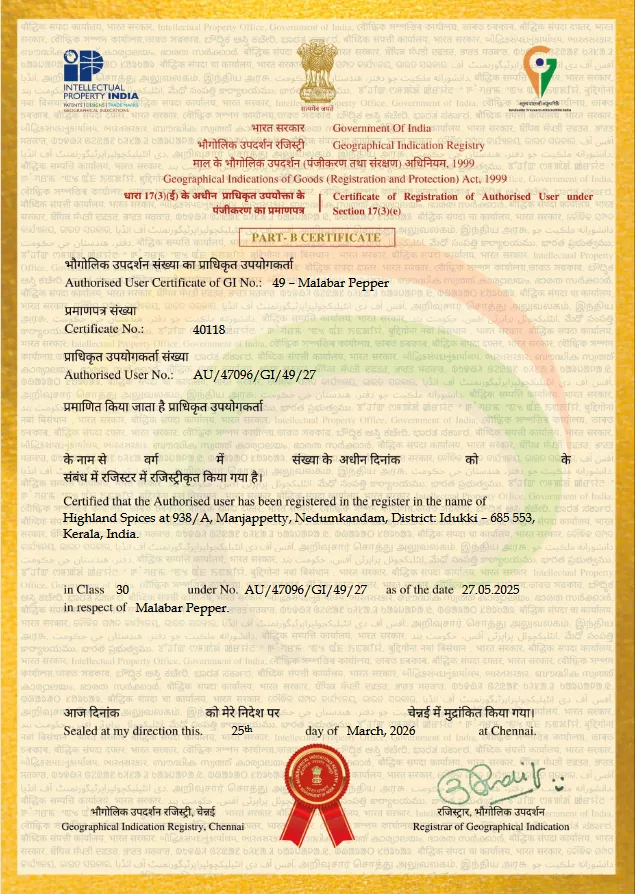
At HIGHLAND Spices, we are proud to be associated with a spice that represents India’s rich agricultural heritage and its continuing contribution to the global spice industry.
What Makes Malabar Black Pepper Special?
Malabar Black Pepper is valued for its characteristic appearance, natural pungency and aromatic profile. Its distinctive qualities have contributed to its reputation among traditional spice varieties.
-
-
Distinctive Black Peppercorn Appearance
-
Dried Malabar Black Peppercorns generally have a dark brown to black colour with a naturally wrinkled outer surface. The berries are approximately spherical, with their appearance influenced by maturity and post-harvest processing.
-
-
Natural Pungency
-
The characteristic sharpness of black pepper is primarily associated with piperine, a naturally occurring alkaloid present in the peppercorn. It contributes to the familiar warm, biting sensation that makes black pepper one of the world’s most widely recognized spices.
-
-
Rich Aromatic Profile
-
Black pepper contains several naturally occurring volatile compounds that contribute to its characteristic fragrance. These aromatic components give the spice its distinctive sensory identity.
-
-
Geographical Identity
-
One of the most important aspects of Malabar Black Pepper is its recognized geographical identity. Its GI status connects the product to designated growing regions and the reputation developed through traditional cultivation.
-
-
Traditional Agricultural Heritage
-
Pepper cultivation in South India reflects generations of agricultural knowledge. Farmers have developed traditional methods of growing, supporting, harvesting and processing pepper vines, contributing to the region’s established spice-growing reputation.
Malabar Pepper and the Spice Heritage of Kerala
Kerala has long been recognized as one of India’s important spice-producing regions. Its tropical climate, seasonal rainfall, varied elevations and agricultural landscapes have supported the cultivation of several valuable spices.
The Western Ghats, in particular, are closely connected with the cultivation of black pepper, cardamom, cloves and other plantation crops.
The history of Malabar Pepper is closely linked with the historic spice trade. For centuries, black pepper from India’s southwestern coast attracted traders from different parts of the world. It became one of the most important commodities exchanged through maritime trading networks.
This history helped establish Malabar as a prominent name in international spice commerce.
Even today, the region’s pepper-growing traditions continue to contribute to India’s position in the global spice market.
The GI recognition of Malabar Pepper helps preserve this connection between geographical origin, agricultural knowledge and regional reputation.
Traditional Pepper Cultivation and Processing
The journey of black pepper begins in the plantation, where pepper vines grow under suitable tropical conditions.
Pepper is a climbing perennial vine that traditionally uses living support trees or other suitable structures. The growth and development of the vines require proper management, suitable moisture conditions and attention to seasonal changes.
The harvesting stage is particularly important. Pepper berries develop in clusters known as spikes, and harvesting is carried out according to their maturity.
For the production of black pepper, mature berries are harvested and dried. During drying, the berries develop their characteristic dark appearance and wrinkled outer surface.
Post-harvest handling, including appropriate drying, cleaning and storage, plays an important role in preserving the physical and aromatic characteristics of the peppercorns.
These cultivation and processing practices form part of the agricultural knowledge associated with traditional pepper-growing communities.
The Importance of GI Recognition for Spice Buyers and Consumers
In today’s spice market, buyers increasingly value product origin, authenticity and traceability. Geographical Indication recognition provides an important connection between a product and its recognized regional identity.
For wholesale buyers, exporters, retailers and consumers, the GI identity of Malabar Black Pepper offers an additional dimension when evaluating the product.
It helps distinguish a geographically recognized product from generic black pepper sold without a specific regional identity.
GI recognition also supports awareness of traditional agricultural products and encourages the preservation of their reputation.
For spice-growing communities, it highlights the importance of regional farming traditions and the contribution of local agricultural knowledge.
At HIGHLAND Spices, we believe that awareness of geographical identity is an important part of appreciating authentic Indian spices.
HIGHLAND Spices: Rooted in the Spice Heritage of Idukki
Nestled in Manjapetty, Nedumkandam, in Udumbanchola Taluk of Idukki District, Kerala, HIGHLAND Spices is closely connected with the rich spice-growing heritage of the Idukki highlands.
Our brand reflects an appreciation for the natural richness of Kerala’s spice-growing landscapes and the traditional agricultural communities that contribute to India’s spice industry.
We believe that authentic spices deserve recognition for their geographical identity, natural characteristics and the farming traditions behind them.
Our association with Malabar Black Pepper as an authorised GI tag user is an important part of this commitment.
Alongside Malabar Black Pepper, our range of whole spices reflects our focus on the distinctive spice heritage of Kerala, including Alleppey Green Cardamom, Idukki Cloves, Highrange Red Mace and other carefully selected spices.
Through HIGHLAND Spices, we aim to connect customers, wholesale buyers and international markets with the authentic character of Indian spices.
Our Commitment to Authenticity and Quality
At HIGHLAND Spices, we understand that trust is built through consistency, transparency and respect for product identity.
Our association with the GI-recognized Malabar Black Pepper reflects our appreciation for the geographical heritage of this traditional spice.
We value the efforts of farming communities, the importance of responsible sourcing and the care required in handling whole spices.
Our commitment is to offer authentic spice products while respecting their origin and the traditions that give them their identity.
For us, preserving spice heritage is not just about protecting the name of a product. It is about recognising the people, agricultural knowledge and regional traditions behind it.
Conclusion: Celebrating the Legacy of Malabar Black Pepper
Malabar Black Pepper represents a remarkable chapter in India’s spice heritage. Its historical importance, geographical identity and traditional cultivation practices have helped establish its reputation among the world’s recognized spice varieties.
The GI recognition provides formal protection for this valuable geographical identity, while authorised-user registration establishes the recognized status of eligible users.
At HIGHLAND Spices, we are proud to be an Authorized GI Tag User of Malabar Black Pepper. We consider this recognition a meaningful connection to Kerala’s traditional spice-growing heritage and an encouragement to uphold the authenticity associated with this remarkable spice.
As we continue to bring premium whole spices to customers across India and international markets, our focus remains on authenticity, geographical heritage and the distinctive character of Indian spices.